The Employment Leave Act 2026 received Royal Assent on 6 August 2026, replacing the Holidays Act 2003 with a new framework for employment leave.
Most provisions come into force on 6 August 2028, giving employers a two-year transition period to prepare their people, payroll systems, data, policies and processes.


The Employment Leave Act 2026 changes leave entitlements, calculations, payment methods, record keeping and remediation, and the detail runs well beyond what any web page can responsibly summarise.
What follows is not a summary of the Act. It is an orientation to the small number of structural shifts that determine the shape of an implementation programme. For the complete picture, refer to the legislation and to MBIE's published guidance, both linked below. For how the detail applies to your workforce, that is the work of an impact assessment.
Leave moves from being measured in weeks and days to being measured and paid in hours. Annual and sick leave accrue in hours against an employee's standard hours from the first day of employment. Alternative holidays also shift to hours-based accrual. Existing balances will need to be converted from days into hours.This single change touches accrual logic, balance display, leave requests, payment calculations, reporting and every historical record you carry forward.
Accrual and payment now depend on how an employee's hours are classified. The Act distinguishes standard hours, additional hours and casual hours, each defined in the legislation. Additional and casual hours attract a leave compensation payment rather than accrual.
For salaried, fixed-roster workforces the classification is often clear. For rostered, seasonal, part-time and mixed-arrangement workforces it is a substantive exercise, and it is not one a payroll system can perform for you. It has to be resolved from employment agreements, rostering practice and how work is actually offered and accepted.
Leave payment moves to an hourly rate applied consistently across leave types, and public holiday entitlement is assessed under a new Otherwise Working Day test. Alongside these, the Act makes further changes to bereavement leave, family violence leave, parental leave interactions, record keeping and the remediation of historical underpayments, each with its own detail and commencement.
The question for most employers is not what the Act says. It is which of its provisions materially affect their workforce, their agreements, their data and their systems, and in what order those need to be addressed.
PPS is working through the Act provision by provision and publishing as we go. Each session takes one area in depth rather than covering everything at a surface level.
Ongoing sessions and commentary on how each part of the Act plays out in practice.
Two Years Does Not Mean Two Years to Implement
Although most provisions take effect on 6 August 2028, the practical implementation window available to individual employers may be significantly shorter. Payroll and HRIS providers first need time to interpret requirements, develop solutions and release system changes. Employers then need sufficient time to understand the impact on their workforce, make policy and design decisions, prepare data, configure systems, test calculations and integrations, train teams and communicate changes to employees.
Waiting for a software release before beginning your readiness programme could leave critical decisions, data remediation and testing too late.
A technically compliant system can still produce incorrect outcomes when workforce data, employment agreements, policies, processes and operational decisions are not aligned.
Successful implementation therefore requires more than installing a vendor update. It requires clear business decisions, reliable data, robust processes and people who understand how the legislation should operate in practice.
Before system configuration begins, employers need to understand their current state, identify affected employee groups, assess contractual and policy implications, identify data issues and determine the decisions their technology providers will need them to make.
The earlier those questions are understood, the stronger the implementation programme becomes.
Employment Leave Act Readiness Checklist
Employment leave readiness is a payroll, people, data, process and technology programme.
.png)
Translate the new framework into practical payroll, policy and operational requirements.
Assess employee groups, working patterns, contractual entitlements and collective arrangements.
Define future-state rules, configuration requirements, integrations and vendor responsibilities.
Review leave balances, work patterns, employment status, historical records and manual workarounds.
Redesign how leave is requested, approved, recorded, calculated, paid and communicated.
Validate end-to-end outcomes through scenario testing, parallel runs, reconciliation and review.
Request Access to the PPSL Dynamic Data Tool
THE PPS EMPLOYMENT LEAVE READINESS FRAMEWORK
PPS helps organisations prepare in a way that is evidence-based, practical and sustainable.
This is a structured six-stage approach to moving from uncertainty to implementation assurance.
STEP 1
Understand the legislative changes, establish governance and identify the stakeholders, systems and workforce groups affected.
STEP 2
Assess current payroll practices, employment agreements, policies, workforce data, systems, processes and potential areas of risk.
STEP 3
Translate legislative requirements and business decisions into future-state payroll rules, policies, processes, system requirements and controls.
STEP 4
Cleanse data, resolve policy and agreement questions, document decisions, engage technology providers and prepare implementation plans.
STEP 5
Validate calculations, integrations and end-to-end processes using representative employee scenarios, parallel payrolls and reconciliation.
STEP 6
Independently confirm that the implemented solution, controls and payroll outcomes operate as intended before and after go-live.
The timeline below is an indicative readiness roadmap, not a statutory implementation timetable. Your timing will depend on workforce complexity, existing payroll architecture, vendor release schedules, data quality and how quickly internal decisions can be made.
One fixed point to plan around: the new rules take effect from each employee's first pay period beginning on or after 6 August 2028. Weekly, fortnightly and monthly cycles will therefore cut over on different dates, and parallel running needs to be planned against your own cycle rather than the statutory date.
Establish ownership, review impacts, assess systems and data, and create an initial roadmap.
Confirm requirements, resolve policy questions, cleanse data and redesign processes.
Complete configuration, scenario testing, parallel payrolls, reconciliation and remediation.
Prepare cutover, train teams, communicate changes and complete post-implementation assurance.
How PPS can help
You may need an independent readiness review, specialist support for one part of the programme, or payroll assurance throughout the entire transition. PPS can work alongside your payroll, HR, finance, legal, technology and implementation teams without replacing the expertise you already have.
A structured review of likely workforce, payroll, system and process impacts.
An independent assessment of your current state, risks, priorities and transition needs.
Identification of data gaps, quality issues and remediation requirements.
Independent review of requirements, design, configuration and implementation approach.
Test scenario design, calculation validation, reconciliation and issue management.
Independent confirmation that payroll outcomes, controls and processes are working as intended.
.png)
The Act received Royal Assent on 6 August 2026 and comes into force on 6 August 2028.
The new rules apply from the beginning of an employee's first pay period starting on or after that date, so the practical switchover aligns with your pay cycle rather than the calendar date.
Yes.
The Holidays Act 2003 continues to apply in full until the Employment Leave Act takes effect.
Employers cannot start following the new rules early, even if their systems are ready. Obligations to remediate employees for historical Holidays Act underpayments also continue.
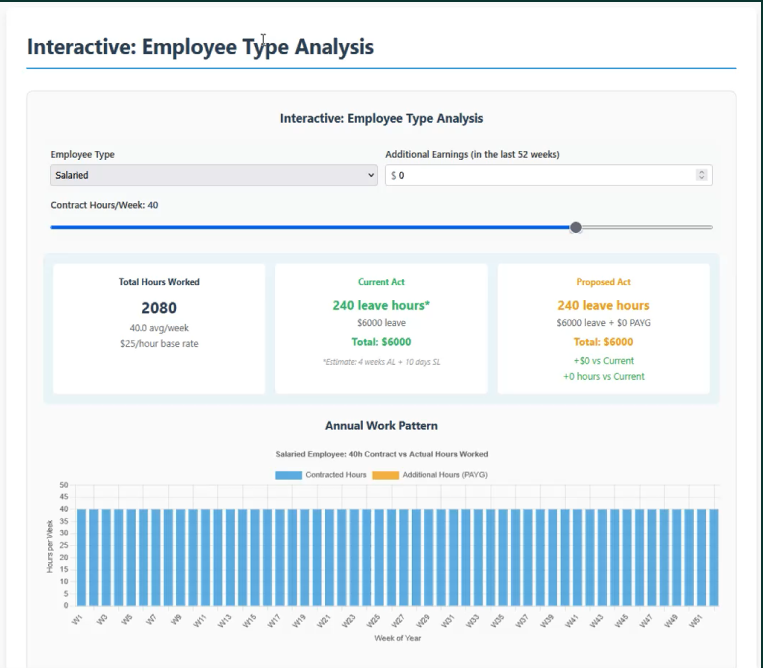
Annual and sick leave will accrue in hours from day one against standard hours, rather than being granted as anniversary entitlements. Additional and casual hours attract a 12.5% leave compensation payment instead of accrual. Leave is taken and paid by the hour at a single rate, part days can be taken, and public holidays are assessed under a new Otherwise Working Day test.
Organisations should avoid making premature configuration changes before requirements and vendor solutions are sufficiently understood. However, readiness work can begin now, including impact assessment, data review, governance, workforce analysis and planning.
No.
System configuration is only one part of implementation.
The Act requires decisions about how each employee's hours are classified, how existing balances convert to hours, and how policies and agreements need to change. Those decisions are inputs to the software, not outputs from it.
Employers may also need to consider employment agreements, policies, workforce data, processes, integrations, testing, controls, training and employee communication.
Preparation can begin well before system configuration. MBIE encourages employers, employees and payroll providers to begin planning now.
Early work should focus on understanding the legislation, assessing the current state, identifying affected employee groups, reviewing data and establishing an implementation roadmap.
Yes.
PPS can provide independent payroll advisory and assurance alongside your existing payroll, HRIS or implementation provider.
Yes.
PPS can support scenario design, calculation validation, parallel payroll testing, reconciliation, issue investigation and post-implementation assurance.
The choice of leading employers in Aotearoa